
More of your buyers are skipping the search results page entirely. They ask ChatGPT for the best backup plugin, they ask Gemini which membership tool to use, and they read Google’s AI Overview and never scroll to the blue links. If your product isn’t part of that answer, it doesn’t exist to them.
The good news is that this isn’t a black box you need to “hack”. Recent data from Ahrefs gives us the clearest picture yet of what AI models actually pull from when they recommend a tool, and for WordPress businesses, the takeaways are refreshingly practical.
The findings are clear, and the moves they point to are doable.
Your Website Is Still the Source of Truth
Before anyone declares websites dead, they aren’t. AI models still treat your site as the canonical record of who you are, what you do, and why anyone should trust you.
Google’s own guidance for AI features in Search boils down to the fundamentals you already know.
- Make your pages crawlable and indexable.
- Write content that actually helps.
- Keep your technical structure clean.
- Show your proof near the top.
In other words, the work that earns you regular search rankings is the same work that earns you AI citations. There’s no secret schema and no magic markup. Clear homepage, clear feature pages, real case studies, and honest answers to the questions buyers actually ask. If a “guru” is selling you a trick that “cracked the algorithm”, save your money.
“Best Of” Lists Are Doing the Heavy Lifting
One finding stands out for WordPress products.
Ahrefs analyzed 26,283 source URLs that ChatGPT cited and found that “best X” list articles made up 43.8% of all the pages it referenced. Best backup plugins, best CRMs, best page builders… The humble listicle is, by a wide margin, the format AI reaches for when someone asks it to recommend a tool.
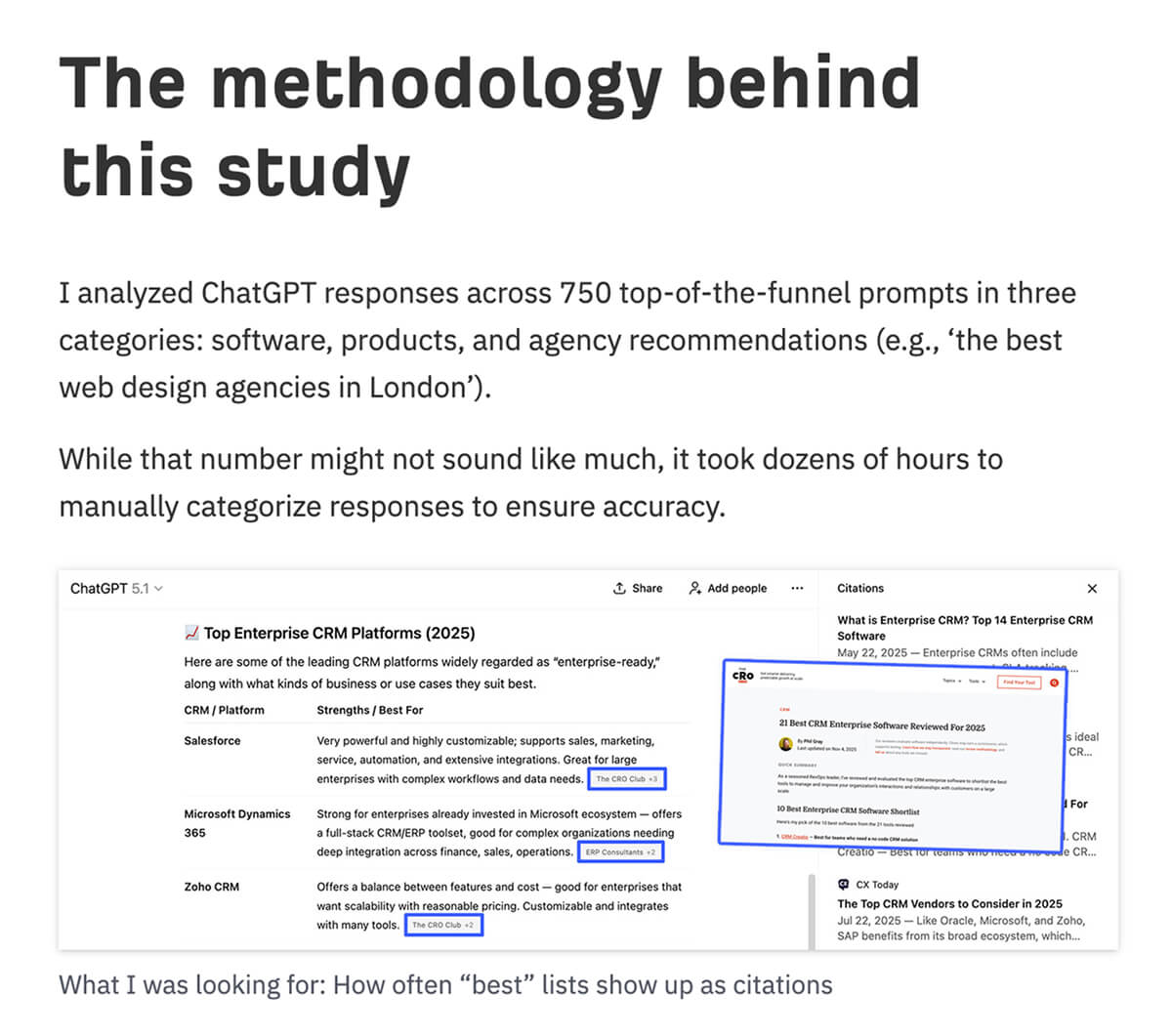
That should reshape how you think about coverage. When ChatGPT is asked “what’s the best WordPress membership plugin”, it doesn’t invent an answer from nothing. It leans on roundups and comparisons that have already done the work of evaluating the options. Being named in those articles is how you get into the recommendation.
| Old Goal | New Goal |
|---|---|
| Rank a listicle to win referral clicks | Get named in listicles so AI cites you |
| Drive traffic to your site | Be present inside the AI answer |
| Win the click | Win the recommendation |
There’s a cost worth naming, too, because Ahrefs found that AI Overviews correlate with a roughly 58% lower clickthrough rate for the top-ranking page. The model often answers the question before anyone clicks anything. So the point of getting listed isn’t only the referral visit you might earn. It’s making sure that when the AI assembles its shortlist, your product is on it.
YouTube Is the Surprise Heavyweight
The single strongest pattern in the Ahrefs research caught a lot of people off guard.
Studying 75,000 brands, Ahrefs found that YouTube mentions had the highest correlation with AI visibility of any signal they measured, around 0.737 across ChatGPT, Google AI Mode, and AI Overviews.
One important caveat is that correlation is not causation. Posting three videos won’t magically make ChatGPT love you, and anyone promising that is overselling. But the pattern makes intuitive sense once you remember that YouTube isn’t really “video” to an AI model. It’s an enormous, searchable database of transcripts. When your plugin shows up in a tutorial, a demo, a review, a podcast clip, or a webinar, that’s text the model can read and learn from.
You don’t need a glossy production. You need clear, useful videos that explain what your plugin does, who it’s for, and what problem it solves. Think a “how to choose the right X” walkthrough, or a setup demo, or even a customer interview.
Boring and genuinely helpful beats slick and empty.
What to Actually Do This Quarter
If you sell a WordPress plugin, theme, or service, here’s the short version:
- Tidy up your core pages. Make sure your homepage and feature pages clearly state what you do, who it helps, and the proof behind it. This is what AI quotes when it describes you.
- Get into the relevant “best of” roundups. Identify the comparison articles your buyers read and make the case to be included. This is now your most direct route into AI recommendations.
- Build a YouTube trail. Even a handful of clear, useful videos gives the models more evidence to work with. Reviews and mentions on other channels count too.
- Earn third-party coverage. The more credible places describe your product accurately, the more confidently AI can recommend it.
None of this is flashy, and that’s rather the point. The businesses that win in AI search are the ones the internet has enough good evidence to describe properly. You build that evidence the slow, reliable way, by shiping something useful, explaining it clearly, showing your proof, and getting other people talking about it.
If you want a head start on the listicle piece, our team maintains full reviews and comparison roundups across the most competitive WordPress categories. Ask how WP Mayor can help you with that, and let’s talk about where your plugin fits.